
The cost of nearly everything is on the rise these days, and college is no exception. Of course, college student budgeting involves more than books and tuition. Students are also going to need a place to live, food, a computer, clothing, and other essentials. Putting together a budget and looking for ways to save on college expenses are crucial to making sure you can get through the school year without being strapped for cash.
A school shopping budget should consider not only tuition costs, but also books, fees, and living expenses, which can vary by location. College HelpGuide.com estimates that on-campus housing with meals costs from $10,000 to $16,000 per year at most Texas universities.
Off-campus housing depends on location and lifestyle choices, while the website indicates that the savings from off-campus living have decreased in recent years. The website recommends budgeting $2,500 to $4,000 per month for all expenses at public universities, including tuition. You can also compare tuition costs at Texas colleges and universities at CollegeSimply.com.
Texas State University estimates its tuition and fees at $12,240 for Texas residents and $25,080 for nonresidents. Additional costs are books and supplies ($790), housing and food ($13,330), and personal, travel and miscellaneous expenses ($4,520).
Midwestern State University reports its undergraduate tuition for the coming year at $10,732 for Texas residents, $11,632 for Oklahoma residents, and $23,570 for international students. Additional costs for those living on or off campus are estimated at $1,000 for books and supplies, $11,814 for housing and meals, $1,600 for transportation, and $2,374 for personal and miscellaneous expenses.

Financial experts recommend that each family break their budget down to spending 50% on their needs, 30% on wants, and 20% on savings and debt. We can break a college student’s budget down like this:
• Needs: Tuition, fees, textbooks, housing, and basic groceries and other essentials such as clothing.
• Wants: Restaurants and food delivery, extracurricular activities, concerts, and nightlife.
• Savings and debt: This may include interest on student loans, credit cards, future tuition costs, and an emergency fund.
Some expenses might blur the lines between wants and needs. Every student needs a computer, but a high-end gaming platform would be something they want but don’t necessarily need. Everyone needs clothing, though some may want expensive brand names and accessories.
An emergency fund for a family would be three to six months of living expenses. CollegeHelpGuide.com recommends that for college student budgeting in Texas, students should add up all their expected costs and multiply them by 1.2 to account for hidden costs and unexpected expenses. It also recommends having at least a $5,000 emergency buffer and keeping tuition increases and inflation in mind when planning for each additional year.
When looking to save money on college expenses, with basic needs such as pens, notebooks, and things for your apartment or dorm room, you’re probably better off buying them somewhere other than the school bookstore. Always ask whether a store or website offers student discounts and look for sales towards the end of summer.
Many laptop manufacturers and software providers offer student discounts. Your school may have student discount programs where you can get software at little to no cost.
Buying used textbooks from your school’s bookstore can save you a significant amount. You might also consider buying them online, renting your textbooks, or seeing if there’s a less expensive digital version. Additional options include:
• Chegg
• eCampus
• Amazon
• eBay
Students at your school might have social media channels on Facebook or Reddit where you can buy, sell, and trade textbooks. The end of each school year can be a great time to acquire these items, as well as furniture that might be offered for free or at a very steep discount. If any classical literature is on your classroom reading list, Project Gutenberg has scores of old books available.
A student savings account and student checking account are important tools for budgeting through the school year. Your checking account can be a place to keep the funds you’re going to use in the near future, such as food, rent, and daily expenses. Your savings account is where you would keep funds for your longer-term needs such as future tuition payments, an emergency fund, and maybe something for spring break.
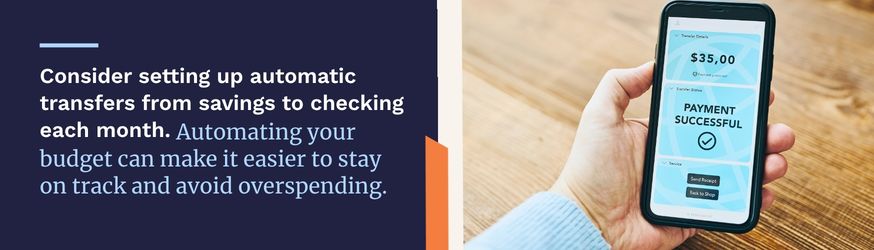
This way you could earn interest on your college savings while reducing the temptation to spend beyond your budget. If you only draw from your checking account for your everyday expenses, you’ll be much less likely to binge on late-night pizza deliveries and other activities. You could also budget for how much you can spend each month and only transfer that amount from your savings to your checking account, or have automatic transfers made every month. This would help you restrict your spending and stay on budget.
Bucketing means breaking your savings and your budget down into individual categories to help you organize your finances. Instead of thinking of your funds as a lump sum amount, separate them according to your different needs. You could do this mentally on a spreadsheet or budgeting app, or physically by separating them into different accounts. This approach should line up with your budget for the school year, where you separate your fixed costs from your variable costs and your longer-term expenses.
If you’re paying rent on an apartment, the next month’s rent would be in your checking account, whereas future rent payments would be held in an account where you could earn interest. Funds for your longer-term expenses could be kept in a regular savings account, in a Money Market account, or certificates of deposit (CDs) where you could earn more interest. With CDs, you could break your budget down into when you need the funds and place them into CDs of different terms so those funds would be available when you need them, and you could lock in a favorable interest rate.

Our mobile banking app, digital banking platform, and a budget app on your phone could make it easier than ever to keep track of your savings and expenses. With our app, you can link all your accounts with any bank and use it to transfer funds between them. You can also use the app and your phone’s camera to make mobile check deposits.
Open a checking or savings account with Moody Bank today. If you need help, just contact us online or visit one of our many locations in Houston, Austin, Friendswood, Galveston, Lake Jackson, New Braunfels, Pasadena, Seabrook, Pearland, League City, Texas City, Sugar Land, and Dickinson.