
A child’s education starts shortly after they’re born. Their parents and families teach them how to speak, walk, count to 10, and learn their ABCs. The earlier your kids learn these skills, the better off they’ll be in life. The same is true for teaching them how to handle money and the importance of saving. We know that many parents are wondering about how to teach kids about money and when they should start.
Research indicates that kids have learned some of their money habits by age 7, and these might not be good ones. Schools can teach them about math, but when it comes to money lessons for kids, their parents and caregivers should start as soon as possible. Kids learn all sorts of lessons from their families, whether intentional or not, just by listening and observing.
Financial literacy for children should start at an early age by teaching them how to identify and count different coins and bills. Explain to them the purpose of money and the different ways of obtaining it, such as a job, as well as other sources, such as babysitting, mowing lawns, and receiving birthday money. Make sure they understand the purpose of money, that it’s something you have to earn and what it’s used for, such as buying groceries, a place to live, and everything from toys to cell phones.

By age three, kids are ready to learn the difference between wants and needs. You could give them examples of each and relate them to your household spending. For example, buying groceries and paying your electric bill are things you need to do. Buying takeout food and subscribing to a streaming service are things you may want to do, but don't necessarily need. Explain to them how you compare and prioritize your family’s wants and needs and how you evaluate your choices when making a purchase. They also need to learn about impulse buying, such as not buying things that you don’t really need just because they’re on sale or grabbing something impulsively near the checkout register.
You might have them identify a few things they want or need and have them place some of their allowance or birthday money into jars or piggy banks, with each one labeled. This can help them see the difference between wants and needs and their financial impact. By avoiding spending on something they want, it’ll be faster and easier for them to afford something they need.
This is also a good time to explain what banks do and the concept of interest payments. You might point out that their money doesn’t earn anything in a piggy bank, but it could grow with interest by keeping it in a savings account. You should also explain to them why it’s important to save for emergencies and use real-world examples. For example, having money set aside in your own savings account makes it easier for you to cover the cost of an unexpected car repair or a medical bill, and avoiding unnecessary purchases beforehand allows you to build up that emergency fund.
At this point, you could start to discuss different careers plus the skills, experience, and education that each of them requires. This is also a good chance to emphasize the importance of education and the impact it can have on their ability to afford things in the future. You can tell them about state and federal income taxes, what they’re used for, and the impact they have on someone’s personal income.
Ask them what their financial goals are and how they can achieve them. If they want a particular toy that “everyone” their age is buying, you can use that as an example of setting goals for how to save up for something. That’s also a good opportunity to explain to them the importance of marketing, advertising, and social media influencers. You can emphasize that many “influencers” are paid to promote things online, just like the ads they see on TV, and how companies use this to convince people to buy things.
This is also a good age to discuss budgeting in a more detailed way. You might break down your family’s budget into fixed expenses, variable expenses, and discretionary expenses. For example:

Have your kids identify their personal wants and needs and set a savings goal for something they really want. Make sure they understand that by curbing their impulse spending, such as not buying a candy bar, they can more easily achieve a larger goal, such as buying a particular toy or video game. This can also be a way to help them curb their impulses. For example, once they save up for something, they might no longer actually want it. Paying them to do simple chores around the house could be a way of emphasizing that you have to work for what you have, and doing so gives you the money you need to cover the wants and needs of yourself and your family.
At this point, your kids might be earning a little income on their own through babysitting or doing yard work for the neighbors. You should help them develop a plan for spending and saving, while identifying their long-term needs, such as saving up for college or trade school. Have them create a method of keeping financial records and identifying their own cash flow as a way to emphasize the importance of budgeting and thinking about finances.
You can also help them identify career options and explain to them the education or training they’ll need for each of their career interests. Show them how to research careers, so they have a good idea of what’s ahead of them and will have plenty of time to consider their choices, while also comparing the income ranges for different careers. This can also be a chance for you to emphasize the importance of an education.
Make sure they understand the difference between checking accounts and savings accounts, as well as the importance of using federally insured financial institutions so their funds are protected. This is also a good age to show them how compound interest works. A kids' savings account is a good way to do this, as their monthly statements will show them how their money keeps growing even when they’re not adding funds—and how the more they save, the more interest they’ll earn.
You could also demonstrate how interest costs can negatively affect them. Many young people fall financially behind when they rack up credit card debts. Make sure your kids understand that compound interest can work against them if they can’t control their impulse spending, and how a credit card bill can rise substantially if they can’t afford to pay it off each month.
As your kids enter junior high and high school, they’re at the age when they can earn more money from odd jobs, such as yardwork, babysitting, and dog walking, and get a part-time job with paychecks and payroll taxes. They can also start learning about building credit. Explain to them what a credit score is, how to keep theirs in good standing, and the impact it can have on their ability to get a job and apply for loans or credit cards. You might also show them how to check their credit score online. They might not yet have a credit score, but checking theirs can be a way for them to measure their progress when they do establish credit. Checking their score can also be a way to look for signs of identity theft, such as any accounts they don’t recognize.
Have your kids draft a personal budget where they split what they spend on themselves versus how much they save, preferably in a savings account that will earn interest. You can emphasize that whatever they don’t spend will benefit them in the long run. You might have them establish a 24-hour rule for any purchases above a particular limit. For example, if they want to buy something above, say $50, they have to wait at least 24 hours before making that purchase. This can help them control their impulse buying and hopefully set them up for a prosperous future.
If your teen is planning on attending college, explain to them the costs involved and how they’ll need to save up for that goal. You could help them compare their options for college and how to pay for it. Even if you already have a college fund, you can tell your teenager that their financial needs in the future could be much more important than whatever they want to spend money on today.
You might discuss various “what if” scenarios with your teens as a way to teach them about handling money. For example, if your car needed an unexpected repair and you had enough set aside in your savings account or emergency fund, you would be able to cover that cost so you could still get to work without taking on credit card debt and the extra cost of interest payments. Ask your teenager to come up with their own scenarios, such as things they might need to spend money on in the future, and how saving ahead of time is the financially responsible thing to do.
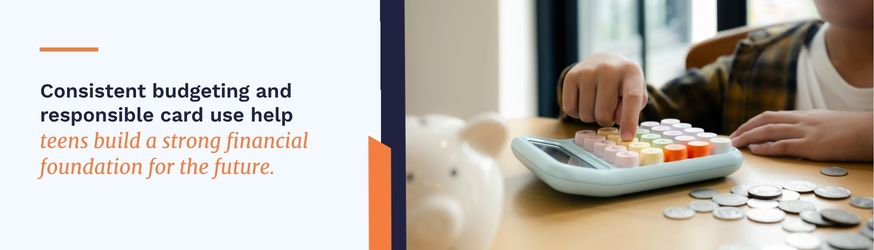
Many teenagers have a debit card, and they might also have a credit card that’s linked to their account, which can be a good way for them to establish credit, and if they need to cover the cost of an emergency. At the age of 18 and older, many young people get a credit card of their own, which can also help them build credit—as long as it’s used responsibly. Explain to them how these cards offer convenience, but they shouldn’t be viewed as a license to spend money or to break their budgets. Make sure that all their spending, whether through cash or cards, is accounted for in their budget so they don’t overspend.
Like many of life’s lessons, teaching your kids about banking and handling money is an ongoing process. By repeatedly and routinely explaining to them where money comes from and the importance of saving and making smart financial decisions, you can help this information sink in until it becomes more of a habit. You might point out to them that buying something on sale doesn’t make sense if it isn’t something that you really need. You might demonstrate how you set goals for yourself and your family, such as saving up for a major purchase or an event (such as a vacation). You could do this with a chart, a budgeting app, or a piece of paper where you show them how you set something aside regularly to meet that long-term goal, and how even small purchases or savings can have a significant impact over time. You could also offer a visual representation, such as putting poker chips, Monopoly money, jellybeans, or just about anything else into different jars that represent how much you have in your savings account that’s allocated towards your goals.
If you’d like to set up a savings account for your kids, please contact us online or visit one of our many locations in Houston, Austin, Friendswood, Galveston, Lake Jackson, New Braunfels, Pasadena, Seabrook, League City, Texas City, Sugar Land, and Dickinson.